Scott County Dog Registration Information
Service Dogs and Emotional Support Animals in Scott, Minnesota
If you’re searching for where to register a dog in Scott County, Minnesota—especially if your dog is a service dog or an emotional support animal (ESA)—the most important detail is that “registration” usually means two different things: (1) local dog licensing through your city (or, in some areas, the county), and (2) legal status under disability-related laws (service dog) or housing-related rules (ESA). In Scott County, dog licensing is commonly handled by the city you live in (if you are inside city limits), while the Scott County Sheriff’s Office provides animal control services for townships (outside city limits).
Where to Register or License Your Dog in Scott County, Minnesota
Use the office list below to contact the most relevant official agency based on where you live in Scott County. If you’re unsure whether your address is inside a city or in a township area, start with the county (general information) or your city hall.
Scott County Government Center (General Information)
- Phone: 952-445-7750
Scott County Sheriff’s Office (Animal Control Services for Townships / Outside City Limits)
- Phone (General Questions): 952-496-8300
- Dispatch (Non-Emergency): 952-445-1411
City of Prior Lake (City Hall)
- Phone: 952-447-9801
- Hours: Monday–Friday, 8:00 a.m. to 4:30 p.m.
City of Savage (City Hall)
- Phone: 952-882-2650
City of Shakopee (City Hall)
- Phone: 952-233-9300
- Hours: Monday–Friday, 8:00 a.m. to 4:30 p.m.
Overview of Dog Licensing in Scott County, Minnesota
Dog licensing is usually local (city-based) within Scott County
A dog license in Scott County, Minnesota is typically issued by the city where you live (if you are within city limits). If you live in a township area outside city limits, animal control services are provided by the Scott County Sheriff’s Office, and you may need to contact county-level services or your township for guidance on what is required in your specific location.
Why licensing exists
Local dog licensing helps communities:
- Confirm dogs are vaccinated (especially rabies vaccination requirements)
- Reunite lost pets with owners faster
- Support animal control operations and local pet-related public health efforts
- Maintain compliance with local ordinances (which may include age thresholds, renewal cycles, and tag display rules)
Service dogs and ESAs can still be subject to local licensing
Even if your dog is a service dog or emotional support animal, local ordinances may still require a license and proof of rabies vaccination. The licensing process is separate from whether your dog qualifies as a service animal or ESA.
What You Need Before Registering a Dog
Common documents and details
While the exact dog licensing requirements in Scott County, Minnesota can vary by municipality, many local licensing offices ask for:
- Rabies vaccination certificate (often required to obtain or renew a license)
- Proof of residency (especially if licensing is city-based)
- Owner identification (such as a driver’s license or state ID)
- Spay/neuter documentation (if your city uses different fee tiers)
- Dog description (breed, color/markings, age, sex) and sometimes microchip information
Rabies vaccination: a frequent requirement
A rabies vaccination record is commonly required for licensing. If your dog is newly adopted or recently moved to Scott County, confirm timing rules with your local licensing office so you don’t run into a renewal or compliance issue.
Steps to Register or License a Dog in Scott County, Minnesota
Step 1: Identify whether your address is inside city limits
This is the most important step for animal control dog license Scott County, Minnesota questions:
- If you live in a city (such as Prior Lake, Savage, or Shakopee), dog licensing is often handled by City Hall or the City Clerk.
- If you live in a township (outside city limits), the Scott County Sheriff’s Office provides animal control services for townships; contact the Sheriff’s Office or county general information to confirm what licensing or registration steps apply.
Step 2: Gather paperwork
Have your rabies certificate and any applicable residency/ID documents ready before you call or visit. This reduces back-and-forth and helps staff confirm what fee category applies (if your city uses spayed/neutered vs. unaltered tiers).
Step 3: Apply and pay the licensing fee (if required)
Most cities issue a license after verifying vaccination and collecting the fee. In many places, you’ll receive a tag. Ask whether renewals are annual and whether the tag must be attached to your dog’s collar when off your property.
Step 4: Ask how service dogs or ESAs are handled locally
If your dog is a service dog or emotional support animal, ask whether the city has any specific local form fields (for example, for records or fee categories). Keep in mind: this is still licensing, not a federal “registry.”
Service Dog Laws in Scott County, Minnesota
No universal federal registry for service dogs
If you’re asking “where do I register my dog in Scott County, Minnesota for my service dog,” it’s important to separate legal recognition from local licensing. In the U.S., service dogs are not established through a single official federal registry. A service dog’s role is defined by what the dog is trained to do to assist a person with a disability, and the applicable laws focus on access rights and handler responsibilities rather than a centralized registration process.
Local licensing can still apply
Even when a dog is a service animal, local governments may still require standard licensing (and rabies vaccination proof). So, you may need both:
- Local dog license through your city (or relevant Scott County township-based process)
- Training documentation for your own records (not always required to be shown, but helpful in certain situations)
Emotional Support Animal Rules in Scott County, Minnesota
ESAs are different from service dogs
Emotional support animals (ESAs) generally relate to housing situations and do not have the same public access rules that apply to service dogs. If you’re trying to figure out where to register a dog in Scott County, Minnesota for an ESA, you typically still follow the same local licensing process as any other dog (rabies vaccination documentation is commonly required).
Local licensing vs. ESA documentation
In practice, you may have two separate tracks:
- City/county licensing: a municipal process related to vaccinations and local ordinances
- ESA status for housing: typically supported by appropriate documentation for your housing provider (separate from the city’s licensing process)
Dog License vs. Service Dog vs. Emotional Support Animal (Comparison)
| Category | What it is | Who handles it in Scott County, MN | Common requirements |
|---|---|---|---|
| Dog License | A local government license/record for your dog (often tied to rabies vaccination and local ordinances). | Often your city licensing office / City Hall (if within city limits). For township areas, start with Scott County Sheriff’s Office (animal control services) or county general information to confirm the correct process. | Typically rabies vaccination proof; owner/residency info; fee payment; renewals (often annual) depending on your municipality. |
| Service Dog | A dog trained to perform tasks for a person with a disability (legal status is based on training and function, not a single registry). | Not “registered” through one universal federal registry. You may still need a local dog license through your city/township process. | Task training related to the disability; handler responsibilities; local licensing/rabies proof may still apply. |
| Emotional Support Animal (ESA) | An animal that provides emotional support; generally relevant to housing contexts and not the same as a service dog. | ESA status is not established by a universal government registry. For local rules, you still follow dog licensing where you live in Scott County. | Typically subject to local licensing rules like rabies vaccination proof; separate housing documentation processes may apply. |
Frequently Asked Questions
What You May Need
-
1Proof of rabies vaccinationCommonly required for a dog license in Scott County, Minnesota municipalities.
-
2Proof of residencyMay be needed when licensing is handled by your city.
-
3IdentificationA driver’s license or state ID is often sufficient.
-
4Spay or neuter documentation (if applicable)Some cities set different license fees based on alteration status.
-
5Payment for licensing feeAsk your local office what payment methods they accept.
Disclaimer
Local laws, fees, office locations, and contact details can change. Residents should verify the most current information with their local animal services or licensing office in Scott County, Minnesota.
Quick clarity: “Registration” means different things
- Local dog licensing: a city/township requirement (often linked to rabies vaccination).
- Service dog status: based on training and disability-related tasks; not a single registry.
- ESA status: typically relevant to housing; still separate from local licensing.
Register A Dog In Other Minnesota Counties
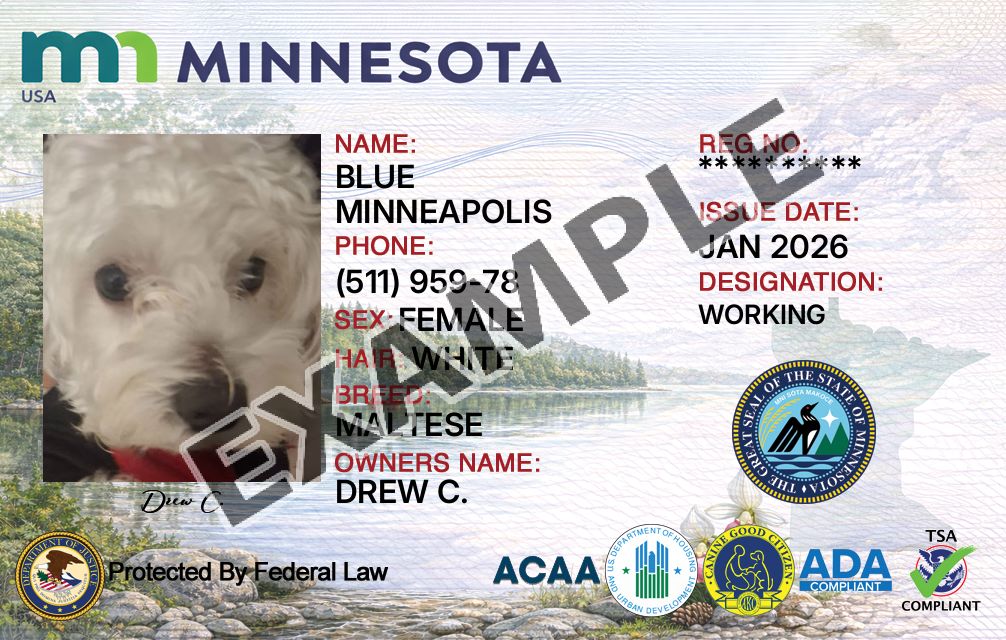
Select your county below to get started with your dog’s ID card. Requirements and license designs may vary by county, so choose your location to see the correct options and complete your pup’s registration.
- Aitkin County Dog Registration
- Anoka County Dog Registration
- Becker County Dog Registration
- Beltrami County Dog Registration
- Benton County Dog Registration
- Big Stone County Dog Registration
- Blue Earth County Dog Registration
- Brown County Dog Registration
- Carlton County Dog Registration
- Carver County Dog Registration
- Cass County Dog Registration
- Chippewa County Dog Registration
- Chisago County Dog Registration
- Clay County Dog Registration
- Clearwater County Dog Registration
- Cook County Dog Registration
- Cottonwood County Dog Registration
- Crow Wing County Dog Registration
- Dakota County Dog Registration
- Dodge County Dog Registration
- Douglas County Dog Registration
- Faribault County Dog Registration
- Fillmore County Dog Registration
- Freeborn County Dog Registration
- Goodhue County Dog Registration
- Grant County Dog Registration
- Hennepin County Dog Registration
- Houston County Dog Registration
- Hubbard County Dog Registration
- Isanti County Dog Registration
- Itasca County Dog Registration
- Jackson County Dog Registration
- Kanabec County Dog Registration
- Kandiyohi County Dog Registration
- Kittson County Dog Registration
- Koochiching County Dog Registration
- Lac qui Parle County Dog Registration
- Lake County Dog Registration
- Lake of the Woods County Dog Registration
- LeSueur County Dog Registration
- Lincoln County Dog Registration
- Lyon County Dog Registration
- Mahnomen County Dog Registration
- Marshall County Dog Registration
- Martin County Dog Registration
- McLeod County Dog Registration
- Meeker County Dog Registration
- Mille Lacs County Dog Registration
- Morrison County Dog Registration
- Mower County Dog Registration
- Murray County Dog Registration
- Nicollet County Dog Registration
- Nobles County Dog Registration
- Norman County Dog Registration
- Olmsted County Dog Registration
- Otter Tail County Dog Registration
- Pennington County Dog Registration
- Pine County Dog Registration
- Pipestone County Dog Registration
- Polk County Dog Registration
- Pope County Dog Registration
- Ramsey County Dog Registration
- Red Lake County Dog Registration
- Redwood County Dog Registration
- Renville County Dog Registration
- Rice County Dog Registration
- Rock County Dog Registration
- Roseau County Dog Registration
- Sherburne County Dog Registration
- Sibley County Dog Registration
- St. Louis County Dog Registration
- Stearns County Dog Registration
- Steele County Dog Registration
- Stevens County Dog Registration
- Swift County Dog Registration
- Todd County Dog Registration
- Traverse County Dog Registration
- Wabasha County Dog Registration
- Wadena County Dog Registration
- Waseca County Dog Registration
- Washington County Dog Registration
- Watonwan County Dog Registration
- Wilkin County Dog Registration
- Winona County Dog Registration
- Wright County Dog Registration
- Yellow Medicine County Dog Registration